Disclosure: This article contains affiliate links. If you purchase through one of these links, Beglance may earn a commission at no additional cost to you. Product availability and specifications can change.
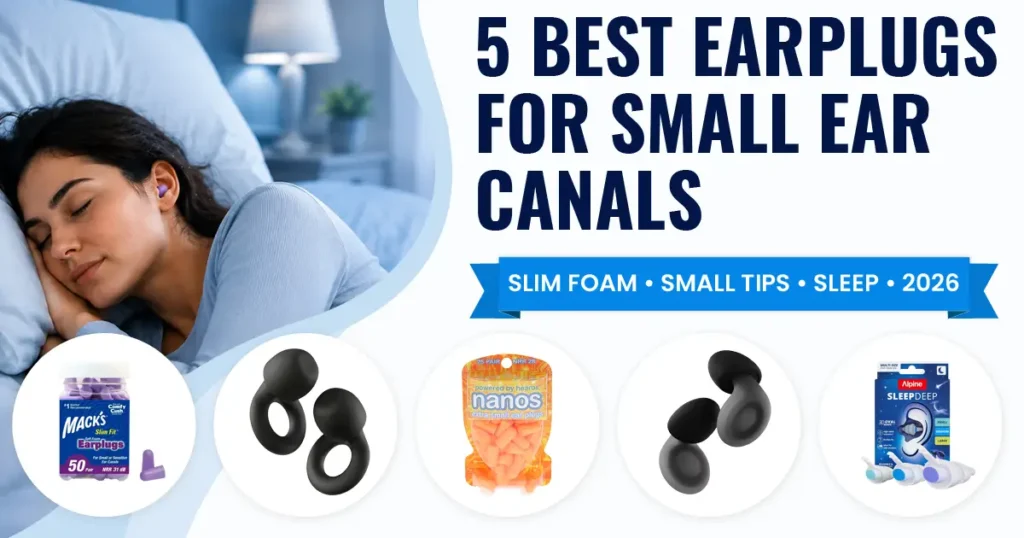
The best earplugs for small ear canals are Mack’s Slim Fit for disposable foam, Loop Dream for side sleeping, Alpine SleepDeep for multiple size choices, HEAROS Nanos for an extra-small foam option and Loop Quiet 2 for washable everyday use. The right choice depends on your ear shape, sleeping position, preferred material and whether you want disposable or reusable earplugs.
Standard earplugs can create uncomfortable pressure when their diameter is too large or when they protrude far enough for a pillow to push them inward. If your current pair causes soreness, read our guide explaining why earplugs hurt your ears before trying another size or design.
Quick recommendations:
- Best small foam earplug: Mack’s Slim Fit
- Best reusable option for side sleepers: Loop Dream
- Best selection of stated sizes: Alpine SleepDeep
- Best extra-small budget foam plug: HEAROS Nanos
- Best washable everyday option: Loop Quiet 2
How We Selected These Earplugs
We compared manufacturer-published sizing, materials, profiles, noise-reduction ratings, cleaning requirements and intended uses. We prioritized products specifically described as slim, extra-small, suitable for smaller ears or available with small tips.
Beglance has not conducted independent laboratory attenuation testing. Published NRR and SNR figures use different rating systems and should not be directly compared as if they were identical measurements. Fit and correct insertion strongly influence real-world performance.
Best Earplugs for Small Ear Canals Compared
| Product | Type | Available Fit | Published Rating | Best For |
|---|---|---|---|---|
| Mack’s Slim Fit | Low-pressure foam | Smaller-diameter profile | 31 dB NRR | Disposable foam users |
| Loop Dream | Reusable sleep earplug | XS, S, M and L tips | 27 dB SNR | Side sleepers |
| Alpine SleepDeep | Reusable oval earplug | S, M and L options | 27 dB SNR | Multiple stated sizes |
| HEAROS Nanos | Extra-small foam | Petite foam profile | 28 dB NRR | Smaller ears on a budget |
| Loop Quiet 2 | Reusable silicone | XS, S, M and L tips | 24 dB SNR | Washable everyday use |
1. Mack’s Slim Fit: Best Small Foam Earplugs
Best for: People who like disposable foam earplugs but find standard foam plugs too wide or firm.
Mack’s describes Slim Fit as a smaller-diameter, low-pressure foam earplug made for small or sensitive ear canals. Its published Noise Reduction Rating is 31 dB. The plug remains similar in length to many conventional foam models, but its slimmer diameter may reduce outward pressure for people with narrower canals.
Foam can also adapt to differences between your left and right ear. Roll the plug into a narrow cylinder, pull the outer ear gently upward and backward, insert it without forcing it and hold it while the foam expands.
Reasons to skip it: These are disposable plugs. Mack’s states that the foam cannot be cleaned and should be discarded when soiled. A slim diameter may also provide an inadequate seal for people with larger canals.
See the official Mack’s Slim Fit specifications.
👉 Check Mack’s Slim Fit on Amazon
2. Loop Dream: Best Reusable Option for Side Sleepers
Best for: Side sleepers who want a low-profile reusable earplug designed specifically for nighttime use.
Loop Dream includes XS, S, M and L oval tips made from foam and silicone. Loop publishes a 27 dB SNR rating and describes the body as low profile, with softer silicone intended to remain more comfortable when the ear rests against a pillow.
The four tip sizes give people with smaller canals more room to experiment than a fixed-size reusable plug. Start with the smallest tip that creates a secure seal without pressure or pain. Each ear may require a different size.
Reasons to skip it: Dream costs more than most disposable foam plugs, and the specialized tips require regular care. No reusable earplug can guarantee comfort for every ear shape.
See the official Loop Dream specifications. You can also read our detailed Loop Dream vs Loop Quiet 2 comparison.
3. Alpine SleepDeep: Best Multi-Size Reusable Option
Best for: Shoppers who want a reusable oval design with clearly published size ranges.
Alpine offers SleepDeep in small, medium and large versions. Its published diameter ranges are approximately 7–11 mm for small, 8–12 mm for medium and 9–13 mm for large. The oval shape is intended to follow the ear canal more naturally, while the soft material is designed for overnight use.
Alpine publishes a 27 dB SNR rating. The availability of multiple sizes makes this one of the more straightforward options when a standard one-size product feels too large.
Reasons to skip it: Measuring or estimating canal fit is imperfect, and even the small version may not suit every ear. The oval design can also feel different from conventional round or tapered plugs.
See the official Alpine SleepDeep specifications.
👉 Check Alpine SleepDeep on Amazon
4. HEAROS Nanos: Best Extra-Small Foam Option
Best for: People with petite ears who want an inexpensive extra-small disposable foam plug.
HEAROS markets Nanos as an extra-small foam earplug for petite ears. Its published NRR is 28 dB. The slim profile may be easier to roll and insert than a wider high-expansion foam plug, especially for someone who experiences pressure shortly after insertion.
Because it is foam, the material gradually expands to help form a seal. Correct insertion is still important: a partly inserted foam plug may protrude and become painful when pressed by a pillow.
Reasons to skip it: Nanos is disposable rather than washable. Its lower published NRR than some full-size foam models should not automatically be treated as poor performance; a comfortable plug that seals correctly may work better than a larger model worn incorrectly.
See the official HEAROS Nanos product information.
👉 Check HEAROS Nanos on Amazon
5. Loop Quiet 2: Best Washable Everyday Option
Best for: Buyers who want soft, reusable silicone earplugs for sleep, travel and concentration.
Loop Quiet 2 comes with XS, S, M and L tips. Loop publishes a 24 dB SNR rating and states that its redesigned tips can fit smaller ears. The silicone construction is washable, making Quiet 2 more economical for regular use than single-use foam.
Quiet 2 is not as sleep-specific as Dream, but its lower-profile circular design may still suit people who do not experience significant pillow pressure.
Reasons to skip it: It may feel firmer against a pillow than Loop Dream, and some sleepers may obtain more published attenuation from correctly fitted foam. If you mainly sleep on your side, compare the two Loop designs before buying.
See the official Loop Quiet 2 specifications.
👉 Check Loop Quiet 2 on Amazon
How to Choose Earplugs for Smaller Ear Canals
Start With the Smallest Comfortable Size
The best earplugs for small ear canals should create a gentle seal without sharp pain, burning, throbbing or persistent pressure. A plug is not automatically better because it feels extremely tight.
If the smallest supplied reusable tip still hurts, switch to a slimmer product rather than forcing it deeper. Your left and right ears may require different sizes.
Consider Foam Versus Reusable Silicone
Low-pressure foam compresses before insertion and then expands inside the canal. It can adapt to irregular shapes but must be inserted correctly. Reusable silicone models are easier to clean and generate less waste, although their fixed bodies may press against the outer ear during side sleeping.
Account for Pillow Pressure
A plug that feels comfortable while sitting may hurt when your pillow pushes it inward. Side sleepers should prioritize low-profile bodies and minimal material extending beyond the ear.
If snoring is the primary problem, compare our best earplugs for a snoring partner. If wearing anything in your ears remains uncomfortable, our guide to white noise versus earplugs explains an external alternative.
Insert Foam Earplugs Correctly
OSHA describes the basic method as roll, pull and hold: roll the entire foam plug into a narrow cylinder, pull the ear upward and backward, insert the compressed plug and hold it in place while it expands. Never force a plug unusually deep.
See OSHA’s hearing-protection fitting guidance and the NIDCD hearing-protector guide.
Stop using the earplugs and seek medical advice if you develop persistent or increasing pain, discharge, swelling, bleeding, significant itching, dizziness or a noticeable change in hearing. Do not place earplugs into an irritated or infected ear.
Final Verdict
For disposable foam, Mack’s Slim Fit is the strongest starting point because it combines a smaller diameter with low-pressure foam. Loop Dream is the most sleep-focused reusable choice for side sleepers, while Alpine SleepDeep offers the clearest range of stated size options.
Choose HEAROS Nanos when you want an extra-small budget foam plug, or Loop Quiet 2 when washable everyday value matters most.
Whichever model you select, comfort and seal matter more than choosing the largest published rating. Review our guide on whether it is safe to sleep with earplugs every night before making nightly use part of your routine.
Frequently Asked Questions
How do I know if my earplugs are too big?
They may be too big if they create persistent pressure, sharp pain, soreness at the canal entrance or repeatedly work their way outward. Try a smaller tip or slimmer foam model rather than forcing the plug deeper.
Can people have different-sized ear canals?
Yes. Your left and right ears can require different tip sizes. Test each side separately and use the smallest size that creates a secure, comfortable seal.
Are foam or silicone earplugs better for small ears?
Neither material is universally better. Slim, low-pressure foam can adapt to the canal, while reusable silicone provides washable tips in multiple sizes. Side sleepers should also consider how far the earplug protrudes.
Should earplugs hurt when they expand?
No. Mild awareness of a new plug is different from pain. Remove the earplug if expansion produces significant pressure, burning or soreness, and try a smaller or lower-pressure design.